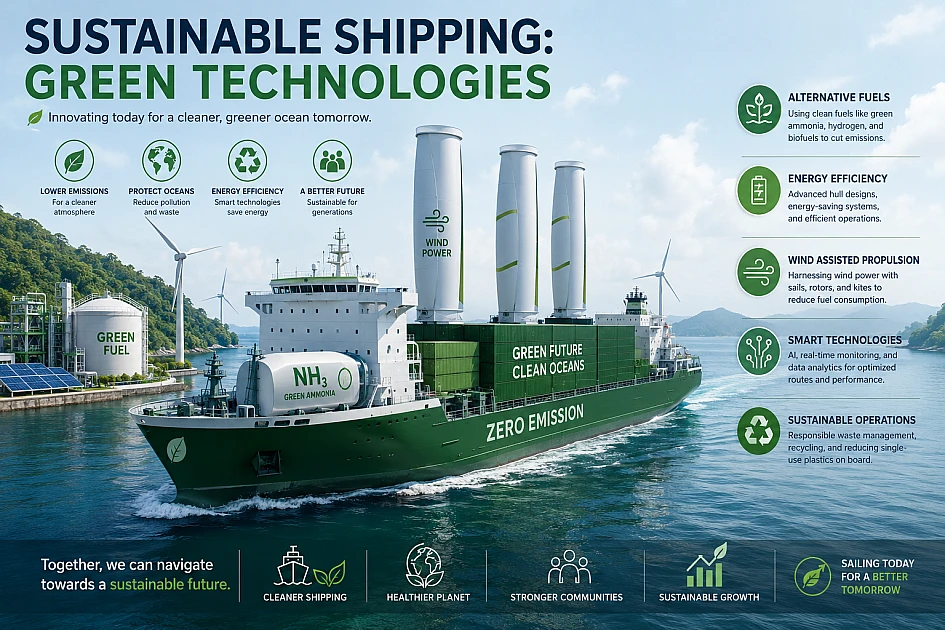
The Green Maritime Revolution: Sustainable Shipping Technologies
The shipping industry faces increasing pressure to reduce its environmental footprint. With the IMO 2050 decarbonization targets approaching — aiming to reduce greenhouse gas emissions by 50% compared to 2008 levels — shipping companies worldwide are investing in sustainable technologies and alternative fuels.
Alternative Marine Fuels
Several alternative fuels are emerging as viable replacements for traditional heavy fuel oil (HFO):
- LNG (Liquefied Natural Gas): Reduces CO2 emissions by 20-25% and virtually eliminates SOx and particulate matter. Currently the most mature alternative fuel technology.
- Green Hydrogen: Zero-emission fuel produced from renewable energy. Ideal for short-sea shipping and port operations.
- Green Ammonia: Carbon-free fuel with high energy density, suitable for deep-sea shipping. Still in early development stages.
- Green Methanol: Biodegradable and cleaner burning than conventional fuels. Maersk has ordered 12 methanol-powered container vessels.
Emission Control Systems
Advanced emission control technologies are helping vessels meet increasingly strict environmental regulations:
- Scrubber Systems: Remove up to 98% of SOx emissions from exhaust gases
- Selective Catalytic Reduction (SCR): Reduces NOx emissions by up to 90%
- Carbon Capture Systems: Emerging technology to capture CO2 from ship exhaust
Energy Efficiency Technologies
From hull optimization and air lubrication systems to waste heat recovery and wind-assisted propulsion, various technologies are helping vessels reduce fuel consumption by 10-30%.
The Road to Zero-Emission Shipping
The maritime industry is on a clear path toward decarbonization. With regulatory pressure increasing and technology costs decreasing, sustainable shipping is not just an environmental imperative — it is becoming a competitive advantage.